
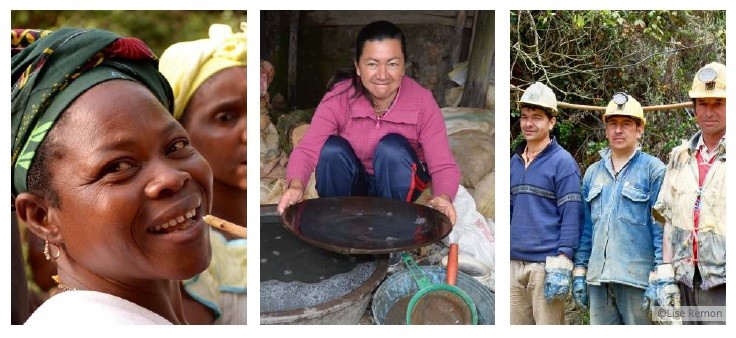
 ©LISE REMON
June 27th 2016
The artisanal and small-scale gold mining (ASGM) sector provides employment for an estimated 20 million people in the developing world, contributing to the livelihoods of over 100 million people, many of them living in Conflict and High Risks Areas (CAHRA). Due to the lack of resources, training and support, this economic activity suffers from widespread informality and is linked to various social and environmental problems.
Following the introduction of the OECD Due Diligence Guidance (DOG), the US Dodd-Frank Act (DFA) and more recent plans for a similar legislation from the European Union, the industry has been adopting mandatory and voluntary responsibility frameworks related to sourcing gold from CAHRA and beyond. However, for the ASGM sector, these regulatory efforts have had little positive impact, and legitimate miners still lack access to legal and just supply chains. Although industry stakeholders have expressed interest in increasing their engagement with the ASGM, an operational and standardized risk management mechanism is necessary combined with support in capacity building, to make sourcing from ASGM viable for the industry.
In consultation with global stakeholders, the Alliance for Responsible Mining (ARM) will develop a new standard which could be used on its own or incorporated into proprietary certification systems. Its aim is to provide access to international markets to legitimate miners early on in their formalization stage, while addressing the most severe forms of risk in ASGM. Considering the importance of compliance with the OECD DOG, the Market Entry Standard will take the OECD Guidance Annex II risks mitigation as a starting point.
However, other risks are also key for responsible supply chain actors when considering their sourcing strategies, which is why the standard would address issues such as major environmental degradation, worst uses of mercury (in line with the Minamata Convention), acutely unsafe and exploitative working conditions, or eradication of child labour and extreme poverty.
For ASGM organizations, additional funds from participation in the certification system, and strong support programs would incentivize tackling these issues and progressively improving their performance. Driven by participation and cooperation of a broad coalition of stakeholders – the industry, donors, public sector institutions and other implementing agencies – the new standard will prioritize cost-effective and flexible yet robust assurances. It will also provide a pathway for artisanal miners and initiatives in a variety of geographies and of different scopes that have advanced the construction of ASGM supply chains free of the worst practices to support companies wishing to source from ASGM through cost-efficient and industry friendly risk management.
The new standard will be developed through a solid, participatory, bottom-up and ISEAL compliant process, but with rapid implementation for early adopters through the Standard’s piloting as part of required consultation processes. This is a project in collaboration with Resolve, an independent organization located in Washington, DC, with expertise in multi-stakeholder and multi-sector collaboration and development of solutions to complex social and environmental challenges. www.resolv.org
Want to participate in the process? Contact our head of partnerships Géraud Brunel : gro.s1792080099enime1792080099lbisn1792080099opser1792080099@lenu1792080099rbdua1792080099reg1792080099